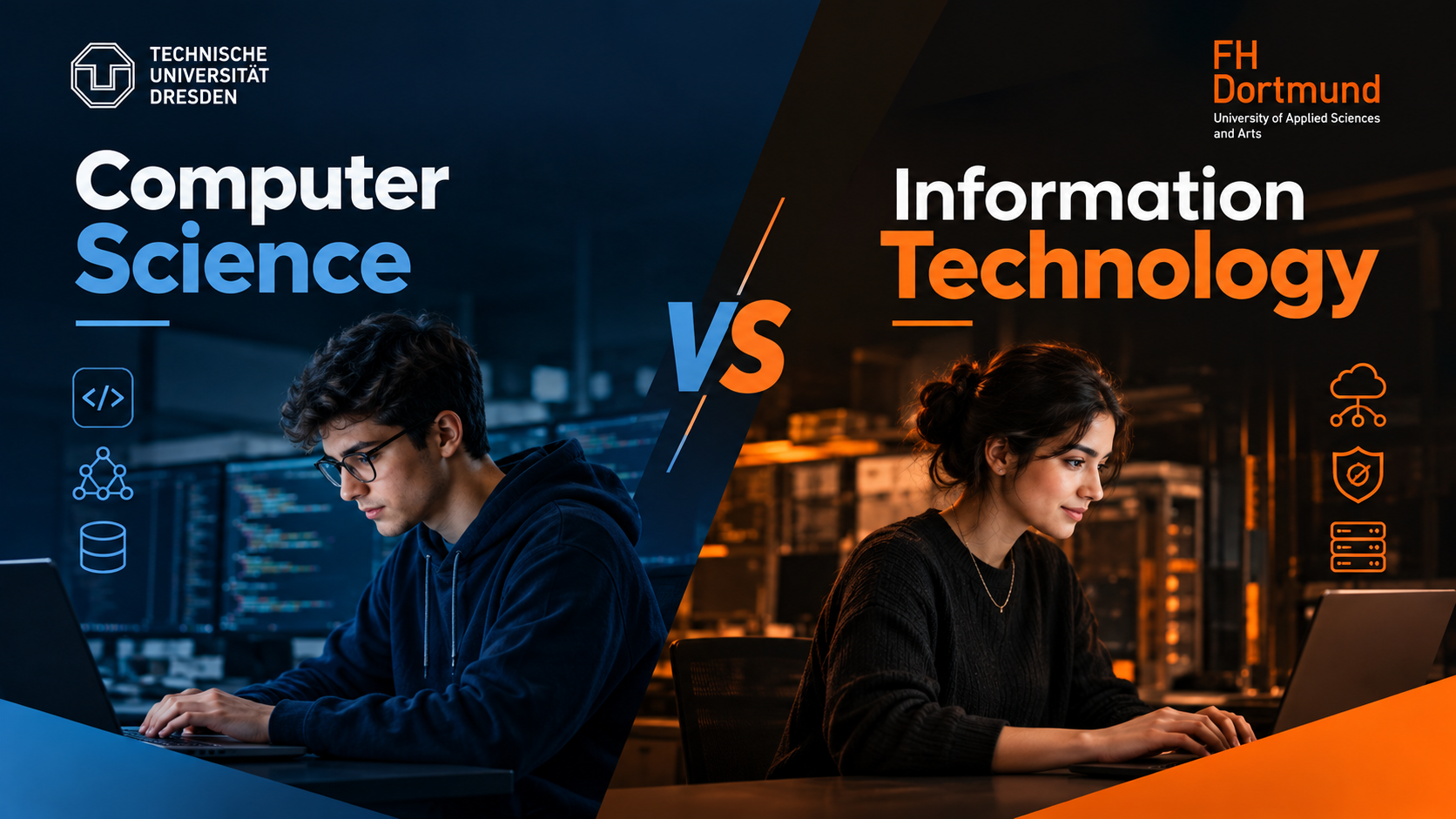
Computer Science vs. Information Technology
What is the Difference?
Students interested in technology often come across two similar-sounding degrees:
B.Sc. Computer Science
and
B.Sc. Information Technology
Both involve computers, programming and modern technology. However, their focus is different.
💻 What is Computer Science?
Computer Science is mainly about computers, software and programming.
You learn how to create software, solve problems using computers and work with digital information.
At TU Dresden, the B.Sc. Computer Science programme includes:
- Programming and algorithms
- Databases
- Operating systems
- Computer networks
- Cybersecurity
- Artificial Intelligence & Machine Learning
- Software Technology
- Data Security
- Computer Graphics
Simply put:
Computer Science = Building and understanding software and computing systems.
If you enjoy coding, software, AI, data or developing digital applications, Computer Science may match your interests.
The B.Sc. Computer Science at TU Dresden has a standard study period of 6 semesters and is taught in German.
⚙️ What is Information Technology?
Information Technology is about using computers and digital technology to solve real-world problems.
At FH Dortmund, Information Technology connects Computer Science and Electrical Engineering.
The programme includes:
- Programming
- Artificial Intelligence
- Data Analysis
- Sensors
- Autonomous Systems
- Robotics
- Augmented & Virtual Reality
- Human-Computer Interaction
- Electrical Engineering
Students can focus on areas such as:
Digital Technologies | Intelligent Mobility | Robotics
Simply put:
Information Technology = Using software, computers and engineering to create smart and connected systems.
For example, this can involve robots, smart devices, autonomous vehicles and connected systems.
🔍 Computer Science vs. Information Technology
| Computer Science – TU Dresden | Information Technology – FH Dortmund |
|---|---|
| Focuses strongly on computing and software | Combines computing with engineering |
| Programming & algorithms | Programming & practical technology |
| Software development | Digital and connected systems |
| AI & Machine Learning | AI & autonomous systems |
| Databases & operating systems | Sensors & electrical engineering |
| Cybersecurity & data security | Robotics & intelligent mobility |
| Computer graphics & software technology | Smart devices & cyber-physical systems |
🎓 TU Dresden vs. FH Dortmund
The difference is also visible in the way the two programmes are structured.
TU Dresden – B.Sc. Computer Science
University focus
The programme provides a broad foundation in mathematics, theoretical, technical and practical computer science. Students can explore areas such as AI, Machine Learning, software technology, embedded computing and data security.
Duration: 6 semesters
Language: German
Degree: Bachelor of Science (B.Sc.)
Start: Winter semester
FH Dortmund – B.Sc. Information Technology
Applied and engineering focus
The programme combines Computer Science with Electrical Engineering and places emphasis on applying technology to areas such as robotics, intelligent mobility and digital technologies.
Duration: 6 semesters or 7 semesters with practical semester/study abroad
Language: German
Degree: Bachelor of Science (B.Sc.)
Start: Winter semester
🤔 Which One Is Right for You?
Ask yourself what you are more interested in:
👨💻 “I want to focus on software, programming, AI and computing.”
→ B.Sc. Computer Science
🤖 “I want to combine computers with engineering, robotics and intelligent systems.”
→ B.Sc. Information Technology
Both are technology-focused degrees. The important difference is what you want to use your computer and technology skills for.
📚 Find Out More
For complete and updated programme information, visit the official university pages:
TU Dresden – B.Sc. Computer Science
Study Computer Science (Bachelor) – TU Dresden
FH Dortmund – B.Sc. Information Technology
Information Technology – FH Dortmund
Interested in studying in Germany?
Join the URH Study Preparation Program to learn more about your pathway to German universities.